The Lost Buildings of South Shields
From the Tyne Dock arches to grand seaside cinemas and the Ingham Infirmary, a tour of the South Shields landmarks that have vanished, and what stands there now.
Every town carries a shadow map of buildings that are no longer there. South Shields, shaped by coal, shipping and the sea, has lost more than its share: grand cinemas that once sat thousands, the great railway arches that funnelled coal to the docks, and a beloved infirmary that served the town for close to 150 years. Some fell to German bombs in the blitz of October 1941, some to the wrecking ball of post-war planning, and some simply outlived their purpose. This is a walk through the South Shields that has vanished, and a note on what took its place.
The Tyne Dock arches
For well over a century, the road into South Shields from the west passed beneath five enormous railway arches at Tyne Dock. Built by the North Eastern Railway from the 1850s, they carried coal wagons from the collieries out to the staithes, feeding a dock that at its peak shipped millions of tons of coal a year. They were so much a part of local life that generations simply knew them as "the arches". By 1977 they were surplus to a shrinking coal trade and stood in the way of a wider road into town, and demolition began that year. Today the A194 and A185 sweep through open ground where the arches once framed the sky, and only old photographs and postcards preserve their scale.
Best for: Best for understanding how completely the coal trade shaped the town's landscape.
The lost cinemas and theatres
South Shields was once packed with picture houses, and the grandest of them have all gone. The Queen's Theatre opened on Mile End Road in 1913 with around 2,400 seats, one of the largest auditoriums in the region, until it was destroyed in the German bombing raid of April 1941. A Jobcentre now occupies the site. On Ocean Road, the art deco Savoy opened in 1938 with more than 1,700 seats, closed in 1982 and was demolished in 1985; the Ocean Road Community Association building stands there today.
Others were quietly repurposed rather than flattened. The Regent on Dean Road in Westoe opened in 1935 as the town's biggest cinema at 1,835 seats, survived a 500kg bomb in 1943, closed in 1966 and became a Mecca Bingo hall until 2014, after which it fell derelict. On King Street, the old Empire opened in 1899 and later ran as the Odeon before closing in 1962, its frontage now part of the Cooplands parade and everyday retail. Just along the same street, the Theatre Royal of 1866 became a cinema in the 1920s, closed in 1933 and its site was later absorbed into the town-centre shops. Almost nobody passing King Street today would guess how much velvet and gilt once stood behind those fronts.
Best for: Best for spotting the ghosts of the silver screen along Ocean Road and King Street.
The Ingham Infirmary
Few losses are mourned as warmly as the Ingham Infirmary at Westoe. For close to 150 years it was where Shields folk were born, mended and cared for, and generations of local nurses trained within its walls. When modern hospital care was consolidated, its work transferred to the new Ingham Wing at South Tyneside District Hospital in 1993, and the old infirmary itself was demolished in 1991 to make way for housing. The name lives on in that Ingham Wing, a deliberate act of remembrance, but the building that so many families carried in their memories is gone.
Best for: Best for a reminder of how much civic pride was invested in the town's public institutions.
The Market Place and the buildings that survived
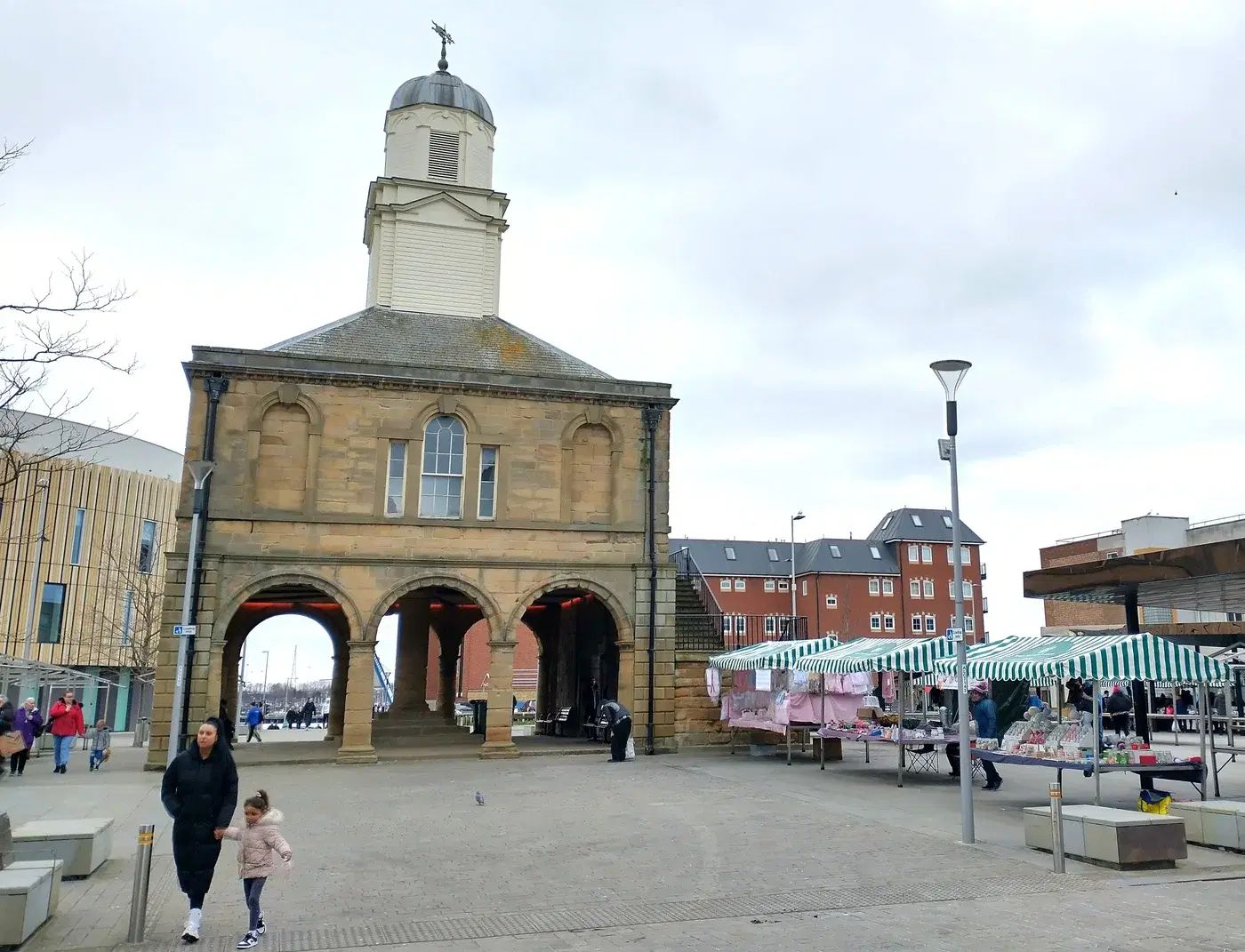
Nowhere shows the town's losses more sharply than the Market Place. On the night of 2 to 3 October 1941 the Luftwaffe devastated the old square, and much of its Georgian and Victorian fabric never returned. The one building that came through the blitz is the little Old Town Hall, commissioned by the Dean and Chapter of Durham in 1768 with an open arcaded ground floor for market stalls. It served as the seat of the town until the grander new Town Hall opened at Westoe in 1910, and it was restored in 1977. It now stands almost alone as a survivor amid the modern South Shields Market that still trades around it, a single stubborn link to the eighteenth-century town.
South Shields is fortunate that some of its finest older buildings did endure. The Customs House of 1863 on Mill Dam, once the working heart of the harbour's trade, has been reborn as the town's theatre and arts venue. Out at the coast, the Marsden Grotto still clings to the cliffs beneath Marsden Rock, and the Roman fort at Arbeia has been excavated and reconstructed rather than lost. Set against the vanished arches, cinemas and infirmary, these survivors are a reminder that heritage is never guaranteed; it is kept.
Best for: Best for appreciating the handful of landmarks that came through the twentieth century intact.
Lost buildings are not really about bricks. They are about the shipyard workers who queued for the Saturday matinee, the coal that thundered over the arches, and the babies delivered at the Ingham. Look closely at South Shields and the absences are everywhere, hidden in a car park, a road junction or a modern shopfront. Knowing what stood there first is one of the quiet pleasures of walking your own town.
Have a suggestion? Get in touch.
Local businesses mentioned
Never miss what’s on
Join the weekly South Shields.org digest — the best events, news and local tips, straight to your inbox. Free, one email a week.
What's On
Noir at the Bar, South Shields
6:00 PM - 8:00 PM · The Word, National Centre for the Written Word, Market Place, South Shields, NE33 1JF
Bay Tales Presents: The Word is Murder, South Tyneside's Crime Fiction Festival
10:00 AM - 5:30 PM · The Word, National Centre for the Written Word, Market Place, South Shields, NE33 1JF
Janet Street-Porter: Still Off The Leash At 80!
See booking page · The Customs House, Mill Dam, South Shields, NE33 1ES