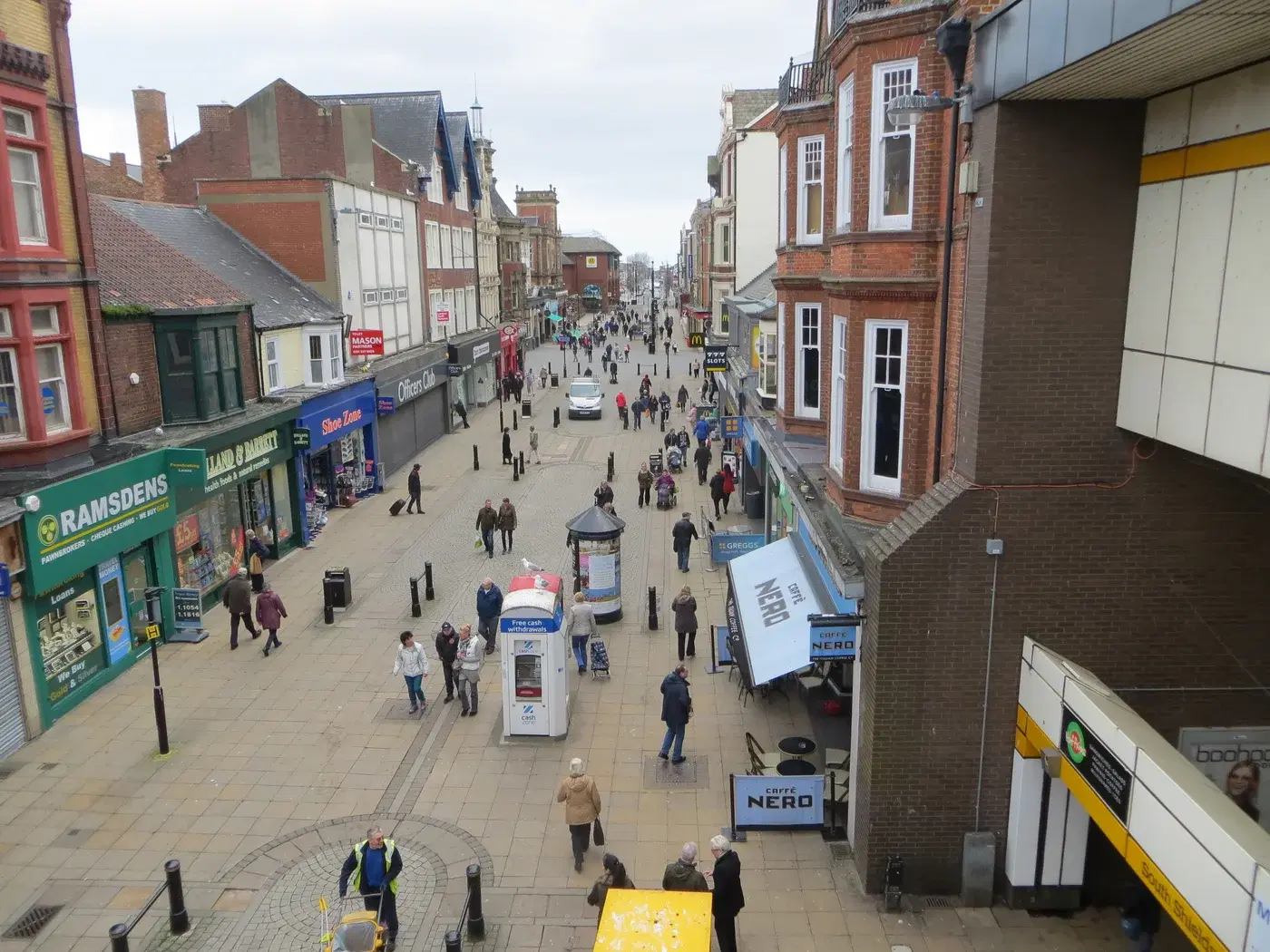
The History of South Shields' High Street and Shopping Streets
How King Street, the Market Place and Ocean Road grew from Georgian fields into South Shields' shopping heart, and where the town centre is heading next.
Every town centre tells a story if you know where to look, and South Shields wears its history openly. Walk the length of King Street on a Saturday, past the market stalls in the shadow of St Hilda's, and you are treading a shopping core that was deliberately laid out more than two and a half centuries ago. This is the story of the streets themselves: how the Market Place, King Street, Fowler Street and Ocean Road came to be, the department stores that once defined them, and the regeneration reshaping them today.
The Market Place and the Old Town Hall
The modern town centre begins in 1768. In that year the Dean and Chapter of Durham, who owned almost all of the land here, persuaded the curate of St Hilda's, the Reverend Samuel Dennis, to release around eight acres of church land for a market and buildings. Two acres were set aside for the Market Square itself, and the remaining six for the surrounding shops and warehouses. A royal charter sanctioned a weekly market and two annual fairs, the first held on 24 June 1771.
At the centre of it all stands the Old Town Hall, a small square building raised on open arches in 1768 to the design of architect John Wooler. Its upper floor held offices and the manorial court; the arcaded ground floor sheltered market traders from the weather. The South Shields Corporation bought the hall and markets from the Dean and Chapter in 1855, five years after the town became a municipal borough. The South Shields Market still trades in the same square today, remodelled in 2016 with a new canopy, stalls and paving.
Best for: Best for standing where the whole town centre began, beneath a Georgian courthouse still ringed by market stalls.
St Hilda's Church, the ancient anchor
Long before any of this, there was the church. St Hilda's Church, the ancient parish church of South Shields, stands on the Lawe Top overlooking the Market Place and the river. It is said to occupy the site of a chapel founded in the seventh century and linked to Hilda of Whitby, though the present building was largely rebuilt through the nineteenth century around an older tower. It is fitting that the land for the town's commercial heart was carved out of St Hilda's own glebe; the church quite literally gave rise to the shops around it.
Best for: Best for the deep roots of the town, an Anglo-Saxon foundation watching over a Georgian market square.
King Street, the principal shopping street
King Street was part of that 1768 land grab, laid out on the six acres reserved for houses and shops. At first it was a genteel address of doctors, solicitors and other professionals, but through the nineteenth century it turned decisively to trade. By 1827 it and East King Street reached all the way to Fowler Street. Gas lighting arrived in 1829, the Stanhope and Tyne Railway was carried across the street on a bridge in 1834, and electric lighting followed in 1896.
By the mid-1800s King Street was firmly South Shields' premier shopping street, its upper floors given over to offices while the ground floors filled with shops, banks and pubs. Much of the frontage you see now was rebuilt in grander style in the late Victorian and Edwardian decades, and several of those handsome buildings are listed. King Street was pedestrianised in the 1980s to make it safer and more pleasant for shoppers, giving it the open, car-free character it keeps today.
Best for: Best for a shopping street with genuine Georgian bones and a Victorian face.
The department store years
For much of the twentieth century a trip into town meant King Street, and King Street meant Binns. The department store on the corner of King Street and Russell Street grew out of the old Fowler and Brock's premises just after the First World War and became the town's must-visit shop for generations, remembered fondly right up to its closure in the 1990s. Marks and Spencer and the local favourite Geordie Jeans were King Street fixtures too. Competition from the MetroCentre, the rise of the supermarkets and wider industrial decline hit the street hard from the 1980s onwards, a pattern familiar to high streets across the country.
Best for: Best for a nostalgic reminder of when a single street held everything you needed.
Fowler Street and Ocean Road
Two other streets shaped the town centre. Fowler Street, once called Sunderland Road, forms the western edge of the shopping core and marked the point King Street had reached by 1827. Ocean Road tells a more colourful story. In 1768 it was open fields; by 1827 it was an unnamed dirt track, and by 1840 it appears in the newspapers as German Street, so named because it led towards the German Ocean, the old name for the North Sea. It was renamed Ocean Road around 1870 as it was built up with terraces and shops.
Ocean Road became the town's cosmopolitan thoroughfare. Italian ice cream parlours arrived from the early 1900s, and from the 1950s Yemeni and South Asian communities gave the street its celebrated run of curry houses, the first Indian restaurant opening in 1958. The street also leads to the South Shields Museum and Art Gallery, which tells the town's multicultural and maritime story in full.
Best for: Best for eating your way along the town's most international street.
From old town hall to new, and beyond
The little 1768 hall was long outgrown, and in 1910 the grand Edwardian Baroque South Shields Town Hall opened on Westoe Road, built at a cost of £78,000 and topped with its landmark 153ft clock tower and copper galleon. It remains the seat of South Tyneside Council. Regeneration has continued in earnest: The Word, the National Centre for the Written Word, opened on the Market Place in 2016, while masterplans propose new food and drink around the market, a performance space at St Hilda's Square and fresh planting and public art along King Street. Down at the river, the £200m Holborn scheme is turning the old docks near The Customs House into a new riverside quarter. The names change and the trades come and go, but the streets first drawn out in 1768 still guide every footstep through the town.
Best for: Best for seeing how a Georgian street plan keeps adapting, one regeneration at a time.
For the town's wider past, from the Roman fort at Arbeia to its shipyards, there is far more to explore across South Shields' heritage. But the shopping streets, more than anywhere, are where that history is still lived every day.
Have a suggestion? Get in touch.
Local businesses mentioned
South Shields Market
Market Place, South Shields, NE33 1JF
St Hilda's Church
Market Place, South Shields, NE33 1DX
South Shields Town Hall
Westoe Road, South Shields, NE33 2RL
The Word
45 Market Place, South Shields, NE33 1DX
South Shields Museum and Art Gallery
10 Ocean Road, South Shields, NE33 2JA
The Customs House
Mill Dam, South Shields, NE33 1ES
Arbeia Roman Fort
Baring Street, South Shields, NE33 2BB
Never miss what’s on
Join the weekly South Shields.org digest — the best events, news and local tips, straight to your inbox. Free, one email a week.
What's On
Noir at the Bar, South Shields
6:00 PM - 8:00 PM · The Word, National Centre for the Written Word, Market Place, South Shields, NE33 1JF
Bay Tales Presents: The Word is Murder, South Tyneside's Crime Fiction Festival
10:00 AM - 5:30 PM · The Word, National Centre for the Written Word, Market Place, South Shields, NE33 1JF
Janet Street-Porter: Still Off The Leash At 80!
See booking page · The Customs House, Mill Dam, South Shields, NE33 1ES