South Shields Docks: A Maritime Heritage Guide
Mill Dam, the coal staithes, the Shields Ferry, the Volunteer Life Brigade, and shipbuilding on the Tyne -- the maritime heritage of South Shields at the mouth of the river.
South Shields exists because of the river. The town grew at the mouth of the Tyne because ships needed to be loaded, piloted, repaired, and rescued there. For centuries, coal flowed down the river and out to sea through South Shields' docks and staithes. Ferries crossed the water. Lifeboatmen watched from the headland. Shipbuilders hammered rivets into hulls. This is the maritime heritage of South Shields -- a town that the river made.
Mill Dam: The Commercial Heart
Mill Dam sits at the point where the River Tyne meets the town. It was the commercial centre of South Shields' maritime life for centuries -- the place where ships moored, cargoes were unloaded, customs officers inspected goods, and the business of the port was conducted.
The name comes from a corn mill that once stood on the site, powered by a tidal inlet. By the eighteenth century, the mill was gone and the area had become a busy quayside serving the coal trade. Warehouses, offices, and pubs lined the waterfront. Pilots, customs men, and shipping agents worked from the buildings around the Dam.
The Custom House
In 1863, the foundation stone was laid for a new Custom House at Mill Dam, designed by the architect T. H. Clemence. The building opened in 1864 and was used by customs officials to monitor the import and export of goods entering and leaving the Tyne. It is an imposing classical building that reflects the scale and importance of the port in the Victorian era.
Today, The Customs House is South Tyneside's premier arts venue -- a 440-seat theatre, cinema, art gallery, restaurant, and bar housed in the listed building overlooking the river. The customs officers are long gone, but the building they worked in has found a remarkable second life.
Best for: The Custom House at Mill Dam was built in 1864 to oversee trade on the Tyne. It is now a theatre, cinema, and arts venue.
Mill Dam Gut
Behind Mill Dam, a tidal inlet known as Mill Dam Gut cut inland. It was filled in between 1929 and 1930, but for centuries it had served as a natural dock for smaller vessels. The filling of the Gut was part of a wider modernisation of the waterfront, as the old tidal creeks and mud flats were replaced by engineered quays and roads.
Coal: The Trade That Made the Town
South Shields' docks owed their existence to coal. The Durham coalfield extended to the south bank of the Tyne, and South Shields sat at the point where coal was transferred from land to sea -- loaded from waggonways and later railways into the holds of waiting ships.
The Harton Staithes
The Harton Coal Company operated one of the most important loading points on the south bank. In 1892, the company took over a site at Mill Dam and built coal staithes -- elevated wooden and steel structures from which railway wagons tipped their loads directly into ships below. Initially, steam trains hauled the coal from Harton Colliery along dedicated railway lines to the staithes; from 1908, the system was electrified.
The Harton Staiths handled enormous volumes of coal destined for London and the south coast. At its peak, the Tyne as a whole was exporting millions of tons of coal a year, and South Shields' staithes were a critical part of the chain.
The Keelmen
Before the staithes were built, coal was transported downstream from the upriver collieries in flat-bottomed boats called keels. The keelmen who worked these vessels were a distinctive community -- tough, independent, and frequently in dispute with the coal owners over pay and conditions. South Shields and the lower Tyne were the territory of the keelmen, and their presence shaped the character of the riverfront for generations.
Best for: The Harton Staithes used electric trains from 1908 to carry coal from the colliery to the docks for loading onto ships bound for London.
The Shields Ferry
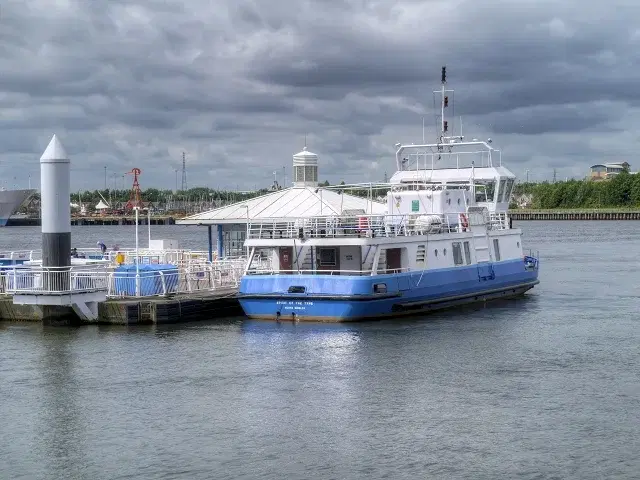
Records suggest that ferries have operated across the Tyne between North and South Shields since at least 1377. For most of that time, the ferry was the only practical way to cross the river at its mouth. Bridges were far upstream; swimming was suicide.
In 1827, a Parliamentary Act was obtained to operate a formal ferry service. From 1830, the ferry carried passengers, cattle, and goods across the Tyne. By 1929, there were a total of eleven ferries crossing the river between Newburn and Tynemouth.
The opening of the Tyne Tunnel between Jarrow and Howdon in 1967 devastated ferry traffic. One by one, the services were withdrawn. Today, the Shields Ferry -- operated by Nexus, the Tyne and Wear Passenger Transport Executive -- is the only ferry service that remains. It runs between North Shields and South Shields, a seven-minute crossing that has been made in one form or another for over six hundred years.
Best for: Ferries have crossed the Tyne between North and South Shields since at least 1377. The Shields Ferry is now the last surviving river crossing by water.
Shipbuilding on the South Bank
South Shields was not just a loading point for coal -- it was also a shipbuilding town. John Readhead and Sons operated the largest shipyard on the south bank, building merchant vessels and warships from the mid-nineteenth century. At its peak, the yard employed thousands of workers and launched ships that traded across the world.
The decline of British shipbuilding in the second half of the twentieth century hit South Shields hard. Readhead's yard closed in 1968 -- part of the same wave of closures that ended shipbuilding at Blyth, Sunderland, and along the Tyne. The riverside sites have since been cleared and redeveloped, and almost nothing visible remains of the yards that once lined the south bank.
The Volunteer Life Brigade
South Shields sits at one of the most dangerous stretches of the North East coast. The rocks known as the Black Middens, at the mouth of the Tyne, wrecked hundreds of ships over the centuries. The treacherous combination of tidal currents, rocky reefs, and savage winter storms made the river entrance a graveyard for vessels.
Founding
The South Shields Volunteer Life Brigade was founded in January 1866 -- inspired by the Tynemouth Volunteer Life Brigade, which had been established two years earlier on the opposite bank of the Tyne. Both brigades were among the very first voluntary life-saving organisations in the world.
The South Shields brigade was the first to save a life from a shipwreck using the breeches buoy -- a canvas seat hauled along a rope between ship and shore that allowed survivors to be rescued one at a time from vessels wrecked on the rocks.
The Watch House
The brigade's headquarters are the Grade II listed Watch House, situated near the South Pier. It is a building of considerable architectural and historical interest, containing a unique collection of shipwreck material, lifesaving equipment, and local history. The Watch House is open to visitors and tells the story of the men who stood on the headland in the worst weather imaginable, watching for ships in distress.
Best for: The South Shields Volunteer Life Brigade, founded in 1866, was the first to save a life using the breeches buoy -- a canvas seat hauled along a rope from ship to shore.
The Tyne Piers
The constant loss of ships on the Black Middens and at the river mouth led to one of the most ambitious engineering projects of the Victorian era: the construction of the Tyne Piers.
In 1850, the Tyne Improvement Commission was established to maintain the river and improve navigation. The first foundations of the North Pier (at Tynemouth) were laid in 1854, with work on the South Pier (at South Shields) beginning in 1856. The project took decades. The South Pier extends 1,570 metres from South Shields -- nearly a mile of engineered stonework protecting the river entrance from the full force of the North Sea.
The piers were completed in 1895, but just two years later were almost completely destroyed by a devastating storm. They were rebuilt by John Wolfe-Barry -- the engineer who designed Tower Bridge in London -- and reopened in 1909.
The South Pier lighthouse, at the end of the South Shields pier, guided vessels safely into the Tyne for over a century. The Herd Groyne Lighthouse, a distinctive red and white structure on the foreshore, also served as a navigation aid. Both are now familiar landmarks and popular walking destinations.
Modern South Shields
The coal has gone. The shipyards have gone. The staithes have been dismantled. But the river is still there, and the town's relationship with it continues.
The Shields Ferry still crosses the Tyne. The Port of Tyne still operates from both banks of the river, handling cargo, cars, and cruise ships. The Customs House still stands at Mill Dam, reinvented as an arts venue. The Word -- the National Centre for the Written Word -- tells South Shields' stories in a striking modern building on the Market Place.
The maritime heritage is not hidden. It is woven into the fabric of the town -- in the street names, the buildings, and the river that flows past them all.
More on South Shields' heritage: read our guides to the history of South Shields, the Arab Quarter and Ocean Road, the heritage walking trail, and Arbeia Roman Fort. Browse the local directory or check what's on this week.
Know something we've missed? Get in touch and we'll add it.
Never miss what’s on
Join the weekly South Shields.org digest — the best events, news and local tips, straight to your inbox. Free, one email a week.
What's On
An Afternoon with Ann Cleeves
1:00 PM - 2:00 PM · The Word, National Centre for the Written Word, Market Place, South Shields, NE33 1JF
Shipwrecks and Smugglers Family Trail at Souter Lighthouse
11:00 AM - 4:00 PM · Souter Lighthouse and The Leas, Coast Road, Whitburn, Tyne & Wear, SR6 7NH
South Shields Market
9:00 AM - 3:00 PM · Market Place, South Shields, NE33 1JF